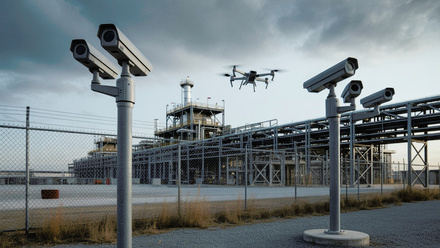
Perimeter security at a turning point
Set against a backdrop of accelerating hybrid threats and a rapidly evolving regulatory landscape, the event marked a pivotal moment: the formal launch of a strategic, cross-sector dialogue on the future of perimeter protection in Europe.
From the outset, the message was clear: Europe’s critical infrastructure is exposed to more complex risks than ever before, and only coordinated action can strengthen its resilience. As highlighted in the opening presentation, the protection of essential services now takes place in an environment shaped by geopolitical instability, climate pressures, cyber intrusions, and hybrid attacks that simultaneously exploit digital and physical vulnerabilities.
This article gathers the core insights from the presentations, draws conclusions from the discussions in Athens, and outlines the path toward the next milestone: the 2026 Brussels Round Table.
A threat landscape transformed
Athens served as a sobering reminder that the traditional borders of security have shifted. Critical infrastructure—including energy, transport, digital services, water, health, and manufacturing—is not merely at risk from isolated incidents but from coordinated hybrid operations that combine cyberattacks, disinformation, sabotage, and physical incursions.
Emerging attack vectors highlighted during the event include:
- Drones and autonomous robotics used for reconnaissance or intrusion
- Mobile surveillance evasion techniques
- bypassing of legacy sensor technology
Such concerns align closely with the European Union’s evolving priorities. The second presentation underscored that Europe’s dependency on non-EU systems, fragile supply chains, and rising geopolitical frictions have pushed the EU to prioritise technological sovereignty, resilience, and independence.
The new CER Directive, together with NIS2, the Cyber Resilience Act, DORA and the AI Act, creates what was aptly described as a “unified EU resilience ecosystem” designed to reduce vulnerabilities and strengthen continuity of essential services.
For perimeter protection stakeholders, this regulatory shift is not merely administrative—it is strategic. Perimeter detection is explicitly categorised as a critical component of physical protection, directly linked to service continuity, risk assessments, incident reporting obligations, and interoperability expectations.
Standards: a gap that needs closing
A presentation by Steve Lampett, Technical Manager at SSAIB and convenor of CLC/TC79/WG1, focused on External Perimeter Security Systems (EPSS). He highlighted that technology is racing ahead while standards struggle to keep pace.
EPSS, defined as systems designed “to provide detection of intruders in external areas outside of enclosed buildings”, introduce challenges far more complex than traditional indoor intruder alarm systems. Weather, wildlife, people movement, varying terrain, and open environments make detection reliability vastly more difficult.
Yet current standards do not adequately address:
- Detector-specific requirements for outdoor perimeter technologies
- Environmental performance categories tailored to perimeter use
- Integration with intrusion detection, access control, fire systems, and VSS
- Interoperability expectations under EU resilience legislation
The working group responsible for EPSS standards (CLC/TC79/WG1) faces low participation, slow progress, and increasing urgency. The Athens round table made it clear: the perimeter security sector needs a stronger, unified voice in European and international standardisation.
Technology innovation
If the policy context shows urgency, the technology presentations demonstrated possibility.
Jürgen Grasmehr’s (Siemens) presented an overview of cutting-edge perimeter detection systems that reveal a sector undergoing rapid innovation. The “sensor technology kit” showcased during the session illustrated the spectrum of measures—mechanical, organisational and electronic—that must work in concert to produce meaningful protection.
Among the key technological developments that Jürgen presented were advanced video analytics, FMCW radar systems, 3D LIDAR technologies, and drone detection and robotics. These technologies face shared environmental challenges - fog, storms, vegetation, animals - which were demonstrated visually through Siemens’ sensor-benchmarking scenarios. The testing methodologies presented illustrate a maturing sector that recognises the need for predictable, verifiable performance.
A new era of resilience
The discussions in Athens made one thing unmistakably clear: Europe is entering a new era of resilience. With the CER Directive and an expanding framework of cybersecurity regulations reshaping expectations for operators, integrators, and manufacturers, compliance is no longer sufficient—proactive resilience must become the norm. Within this context, perimeter protection has firmly established itself as a strategic priority rather than a peripheral consideration; as emphasised during the opening session, it represents the very first line of defence for critical infrastructure.
At the same time, innovation in the field is accelerating, with AI-driven analytics, video, thermal imaging, radar, LiDAR and drone-detection technologies advancing at remarkable speed. Yet this progress remains uneven, hampered by limited interoperability and the absence of harmonised industry standards. Meanwhile, developments in conventional technologies are continuing apace. Active infrared barriers, microphonic cable, fiber optic systems, ground passing systems and similar technologies are still evolving, and there seems to be no end in sight to this development for the time being. These challenges reinforce another central theme that echoed throughout every presentation: collaboration is essential.
Policymakers, operators, integrators, vendors, and national committees must work more closely together to ensure that technology, policy, and operational needs evolve in alignment rather than in isolation. In this landscape, Euralarm has a pivotal role—with its capacity for advocacy, representation, best-practice sharing, and standardisation efforts, it is uniquely positioned to bridge the ambitions of Brussels with the practical realities of industry, helping to shape a coherent and resilient future for perimeter security across Europe.
A path forward: Brussels 2026
The Athens round table was the beginning - not the conclusion - of a broader movement to strengthen perimeter protection across Europe. Next year, the dialogue continues in Brussels. This next round table will build on the foundations laid in Athens by:
- Broadening participation across more EU Member States
- Deepening the alignment between technology providers and policymakers
- Accelerating progress on EPSS-related standards
- Advancing interoperability and harmonisation efforts
Your voice, expertise, and experience are essential. Whether you are a system manufacturer, integrator, operator, standards expert, researcher, or policymaker, the Brussels round table offers a unique opportunity to influence the future of European perimeter protection at a moment when it truly matters.
Confidence from end-users in perimeter detection systems will need to be strengthened. That can be done by creating robust EN standards, providing clear education, and sharing information and practical guidance. These topics are an industry responsibility that must be actively embraced so our systems and solutions can contribute to a more resilient Europe