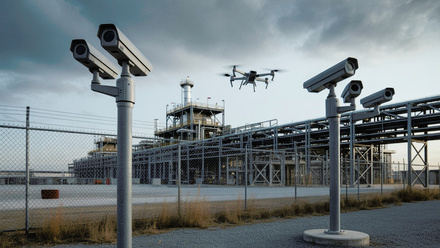
Critical infrastructure under hybrid threats: why perimeter protection is the first line of defence
Energy grids, transport hubs, data centres, and telecommunications networks are now operating in an environment where physical, digital, and information-based threats converge. Recent European Union initiatives reflect a growing recognition that so-called hybrid threats — combining cyberattacks, physical intrusion, sabotage, and disinformation — pose a serious and evolving risk to the continuity of essential services. In this environment, perimeter protection is no longer simply a boundary measure. It is the first line of defence in a layered, intelligence-driven security strategy.
Hybrid threats: a new security reality
Hybrid threats blur the line between conventional and unconventional attacks. They may involve coordinated cyber operations alongside physical intrusion, drone reconnaissance combined with perimeter breaches, or sabotage attempts supported by disinformation campaigns designed to delay response.
For operators of critical infrastructure, this means that traditional, isolated security measures are no longer sufficient. A modern protection strategy must be built around early detection, real-time awareness, and fast, coordinated response — starting at the perimeter. Effective perimeter security now plays a crucial role in identifying threats at the earliest possible stage, before they can escalate into operational disruption, safety incidents, or national security crises.
The role of electronic and perimeter security
Electronic security technologies form the backbone of modern critical infrastructure protection. Perimeter intrusion detection systems provide continuous monitoring of site boundaries, detecting unauthorised access, fence breaches, climbing attempts, and tampering. These systems deliver the first alerts in many real-world incidents, enabling security teams to intervene before attackers reach sensitive assets.
Fire detection, extinguishing, and suppression systems protect against another major hybrid threat vector: physical sabotage leading to fire or equipment damage. When integrated into central monitoring platforms, these systems allow for immediate verification and rapid emergency response.
Situational awareness platforms take protection a step further by consolidating data from perimeter sensors, CCTV, fire systems, access control, and operational technology networks into a single operational picture. Security teams gain real-time visibility of developing threats and can coordinate responses across multiple sites and stakeholders.
Integrated monitoring platforms connect physical security, fire safety, cyber monitoring, and operational control systems, enabling faster decision-making and coordinated incident management. This integration is essential in an environment where attacks are increasingly multi-vector and highly coordinated.
Protecting Europe’s most exposed sectors
The energy, transport, and telecommunications sectors are particularly exposed due to their interconnectivity and strategic importance. A disruption at a single substation, data centre, rail hub, or telecom site can quickly cascade across multiple regions and industries.
Perimeter protection is therefore not only about securing individual locations — it is about safeguarding entire networks. Modern electronic security solutions provide more than detection and deterrence. They deliver the analytics, system health monitoring, and historical data required to identify vulnerabilities, optimise system performance, and continuously strengthen resilience.
Euralarm’s role in building trusted protection
Euralarm plays a central role in this evolving security ecosystem. By promoting European standards and best practices for both electronic security and fire safety, Euralarm ensures that protection systems meet the highest levels of quality, reliability, and interoperability.
In a hybrid-threat environment, trust in security systems is fundamental. Operators must be confident that perimeter detection, monitoring platforms, and fire protection solutions perform reliably, integrate seamlessly, and deliver consistent results under real-world conditions.
Through its advocacy, technical expertise, and extensive member network, Euralarm helps bridge the gap between regulatory frameworks, technology innovation, and operational deployment. In doing so, it supports the development of trusted, resilient protection architectures for Europe’s most critical assets.
From policy to protection
With hybrid threats now high on the European security agenda, investment in advanced electronic and perimeter security is no longer optional — it is essential. As operators align with ProtectEU guidelines and national resilience strategies, the integration of perimeter intrusion detection, situational awareness platforms, and centralised monitoring will be central to safeguarding Europe’s critical infrastructure against the increasingly complex threats of the 21st century. For manufacturers, integrators, and security professionals, perimeter protection is no longer just a technical discipline. It is a strategic capability — and a cornerstone of Europe’s long-term resilience.