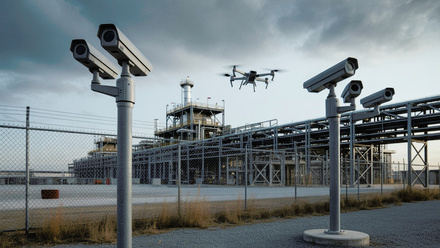
New guidance document on Precautionary measures for protecting vital installations and facilities
The purpose of this document is to illustrate in practice the importance and the basic requirements for physical security and safety in the field of critical infrastructure. In view of the constantly growing threat situation and the interdependencies between the individual sectors, the security of critical infrastructures must not only be understood as a task for individual infrastructure operators. Rather, it is an all-society issue that requires the cooperation of all parties involved - from government agencies to security authorities to private companies and specialized security service providers. Only through this shared responsibility and the continuous adaptation to new threat scenarios can the security and stability of Europe be guaranteed in the long term.

In an increasingly complex and interconnected environment, European societies rely on highly interdependent systems such as energy and water supply, healthcare, transport, and communications. Recent incidents and evolving threat scenarios have underlined how vulnerable these vital installations can be to targeted attacks, natural disasters, and technical failures. Ensuring their continued functionality is therefore essential for social stability, public safety, and economic security.
The guidance builds on the objectives of the European Directive on the Resilience of Critical Entities (CER/RCE), which establishes minimum standards for the protection of critical infrastructures. It emphasizes the importance of cross-sectoral physical security arrangements that complement existing cyber and IT security measures, creating a holistic and integrated security approach. While national implementation timelines may vary, the document highlights that proactive protective measures are both necessary and prudent to mitigate all conceivable risks.
A central focus of the guidance is the role of regular risk analyses and resilience planning. These processes enable operators of critical infrastructures to identify vulnerabilities early, prevent potential threats, and sustainably enhance their ability to withstand and recover from disruptive events.
The document outlines the need for an integrative security strategy that combines structural, technical, and organizational measures. Effective protection can only be achieved through the coordinated application of physical security solutions—such as perimeter protection, access control, intrusion and fire detection, and video surveillance—together with robust cyber security measures. This layered approach creates a comprehensive protective shield tailored to the specific risk profile of critical infrastructures.
Finally, the guidance stresses that protecting vital installations is not solely the responsibility of individual operators. It is a shared, all-society task requiring close cooperation between public authorities, security agencies, private operators, and specialized security service providers. Continuous collaboration and adaptation to emerging threats are essential to safeguarding Europe’s critical infrastructures and ensuring long-term resilience.
The guidance document is intended as a practical reference for policymakers, infrastructure operators, and security professionals involved in the protection of vital facilities.