
Together, these elements ensure that help can be reached quickly - while preserving dignity, privacy and independence.
For the fire safety and security industry, SAAL is no longer a neighbouring field. It is becoming an integral part of modern life-safety infrastructure. Social alarms increasingly interact with building systems, Alarm Receiving Centres (ARCs), fire detection, voice evacuation and smart-building platforms. This convergence creates new responsibilities - and new opportunities - for manufacturers, service providers and integrators.
Within Euralarm, Social Alarming & Assisted Living is recognised as a cross-sector domain where care, security and fire protection meet under shared European standards and service quality expectations. With the establishment of the Task Group Domestic Life Safety within Euralarm we want to extend the work which has been done over the last decades on commercial fire safety and security systems into the residential market. This is triggered by the changes in the way we live, work and travel and the transformation within Europe in terms of advanced electrification/digitization, the ageing population and the urbanization. See the documents related to Domestic Life Safety below.
Resources Domestic Life Safety


What is Social Alarming & Assisted Living?
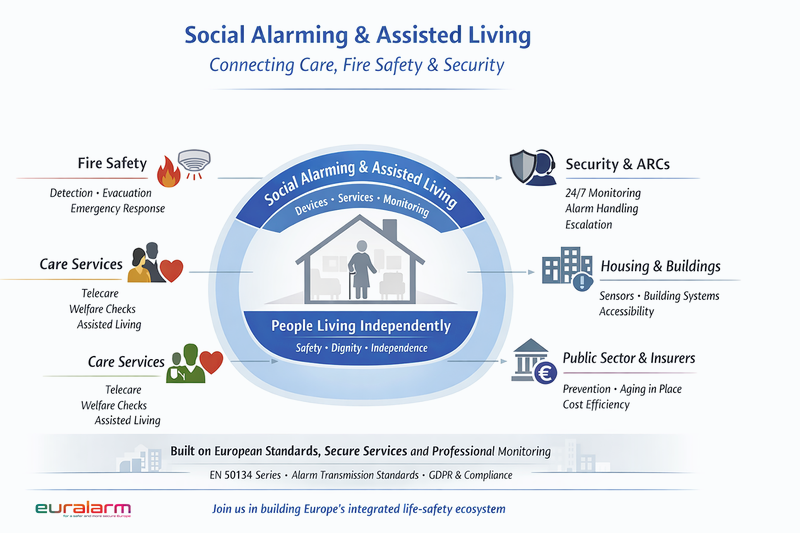
Social Alarming & Assisted Living refers to the integrated set of technologies and services that support vulnerable people — such as older adults or people with disabilities — in their daily lives. Typical solutions include personal emergency alarms, fall detection, inactivity monitoring, smoke and CO sensing, and two-way communication with monitoring centres.
Crucially, SAAL is not only about devices. It relies on a full service chain: installation and commissioning, 24/7 monitoring and alarm handling, escalation to caregivers or emergency services, remote device management, and continuous quality and compliance processes. When designed in line with European standards, these services deliver reliable protection while respecting data protection and user autonomy
The result is “discreet safety”: technology that works quietly in the background, allowing people to remain independent without feeling watched.

SAAL and Fire safety and Security
Social alarms are increasingly deployed alongside — and sometimes integrated with — traditional fire and security systems. In apartment buildings, senior residences and care facilities, personal alarms may connect to building management systems, nurse-call platforms or fire alarm infrastructure. Alarm events are routed through ARCs that also handle intrusion or fire signals.
This convergence changes the role of the fire & security industry in several ways. First, reliability expectations rise. Social alarms protect vulnerable users, so transmission paths, power resilience and response procedures must meet life-safety levels comparable to fire systems. Second, service quality becomes central. Hardware alone is not enough. Monitoring, escalation, maintenance and staff training directly affect outcomes, as reflected in application and service standards such as EN 50134-7. Third, regulatory complexity increases. Depending on intended use, components may fall under medical-device rules, radio equipment requirements and GDPR — all while remaining aligned with alarm-system standards. Finally, integration opens new value. Combined social, fire and security solutions can reduce false alarms, improve emergency response, and support proactive care models that help people stay safely at home for longer.
The European standards foundation
A shared technical baseline already exists. The EN 50134 series defines system requirements, trigger devices, local control units, communications and service delivery for social alarm systems. Complementary standards cover alarm transmission, wireless devices and building automation. These standards are developed in cooperation with European standardisation bodies such as CENELEC and ETSI, providing a common framework for interoperability, safety and quality across Member States. Where solutions are intended for medical purposes, additional obligations apply under EU medical device legislation. All services processing personal data must comply with GDPR. Together, these frameworks ensure that SAAL solutions are not only innovative, but trustworthy.
Euralarm actively promotes awareness and use of these standards among its members, helping align social alarming with established fire and security practices.
Impact across multiple sectors
Social Alarming & Assisted Living sits at the intersection of several domains:
- Fire safety benefits from integrated detection, prioritised response and clearer occupant status during incidents.
- Security services provide professional monitoring, alarm verification and coordinated escalation.
- Care providers gain tools for proactive support and reduced emergency interventions.
- Housing operators improve tenant safety while embedding wellbeing into building infrastructure.
- Public authorities and insurers see reduced hospitalisations and delayed admission to residential care.
For industry, this creates a shift from isolated products toward long-term, service-based ecosystems — where technology, monitoring and response are bundled into sustainable models shared by multiple stakeholders.
Webinars Domestic Life Safety
Euralarm’s role
Euralarm brings together manufacturers, service providers and system integrators from across Europe’s fire and security community. In Social Alarming & Assisted Living, Euralarm focuses on:
- Harmonising technical and service standards.
- Promoting interoperability between social alarms, fire systems and monitoring centres.
- Supporting members in navigating regulatory frameworks.
- Encouraging dialogue with care organisations, housing providers and policymakers.
Through publications, working groups and member collaboration, Euralarm helps ensure that social alarming evolves as part of Europe’s wider life-safety infrastructure — not as a disconnected niche.
Working with Europe’s broader stakeholder community
Beyond the fire & security sector, SAAL aligns closely with European digital health, ageing-in-place and smart-building initiatives supported by bodies such as the European Commission. National authorities, municipalities, care organisations and telecom operators all play key roles in deployment.
Euralarm encourages cooperation across these communities so that solutions developed by its members integrate smoothly into real-world care pathways and building environments.

Join our Social Alarming & Assisted Living initiative
Across Europe, more people are living independently for longer. Social Alarming and Assisted Living (SAAL) enables this shift by combining personal alarm devices. Together, these elements ensure that help can be reached quickly - while preserving dignity, privacy and independence. Euralarm invites stakeholders, experts, solution providers, operators, and policymakers in the field of Social Alarming and Assisted Living to actively contribute to our initiative.